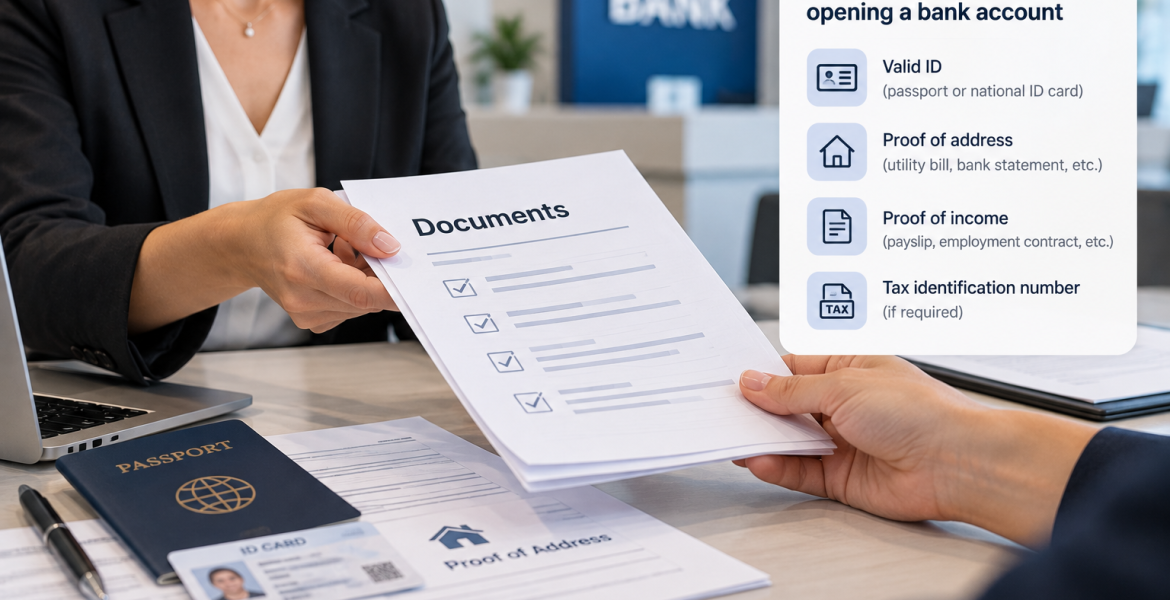
Bank Account Opening Requirements: Documents, ID and Deposit
On 3 September 2026 by HabodakoviTo open a checking or savings account in the U.S., you generally need to provide your full legal name, date of birth, address and an identification number such as an SSN, ITIN or another number the bank accepts. The bank must also verify your identity, commonly using a driver’s license, state ID or passport.
Some institutions may ask for proof of your current address, a second form of identification or an opening deposit. The exact document list and deposit amount depend on the bank and account.
What Do You Need to Open a Bank Account?
For a typical personal bank account, have the following information and documents ready:
| What you may need | Examples |
|---|---|
| Personal information | Full legal name, date of birth, address |
| Identification number | SSN, ITIN or another acceptable identification number |
| Photo ID | Driver’s license, state ID, passport |
| Proof of address | Utility bill, lease or another accepted document if required |
| Contact information | Phone number and email |
| Opening deposit | Depends on account; some require little or no initial deposit |
| Additional identification | May be required depending on the bank and applicant |
Federal Customer Identification Program requirements do not say that every customer must bring exactly two IDs, a Social Security card and a utility bill.
Instead, banks must obtain certain identifying information and follow procedures that allow them to reasonably verify the customer’s identity.
OCC — Identification Requirements for Opening an Account
What Information Is Required to Open a Bank Account?
Federal customer-identification rules require banks to collect core identifying information when establishing a new account.
Full Legal Name
Use the name shown on your identification documents.
Differences between the application and your ID can lead to requests for additional verification.
Date of Birth
For an individual customer, the bank needs your date of birth as part of its identification process.
Address
The bank must obtain an address.
The exact format it accepts can depend on your circumstances and the institution’s policies. Applications may also ask separately for a mailing address if it differs from where you live.
Identification Number
For U.S. customers, this commonly means a taxpayer identification number such as a Social Security number.
Federal rules also contemplate alternative identifying information for certain non-U.S. persons, such as:
- a taxpayer identification number;
- passport number and country of issuance;
- alien identification card number;
- certain other government-issued identifying numbers.
Most consumer applications will tell you which number the particular bank accepts.
The important distinction is that the bank needs enough information to identify you, but the application process is not identical at every institution.
What Documents Do You Need to Open a Bank Account?
There is no single document checklist that applies to every U.S. bank.
Government-Issued Photo ID
Common forms of identification include:
- driver’s license;
- state identification card;
- passport;
- military ID.
Some institutions may also accept foreign passports or consular identification documents.
If you do not have one of the IDs listed on the bank’s website, contact the bank before applying rather than assuming you cannot open an account.
Proof of Address
Some banks may request a separate document showing your current address, particularly when the address on your identification is different.
Possible documents can include:
- a recent utility bill;
- lease;
- other official correspondence accepted by the institution.
The bank decides what forms of proof it accepts.
Second Form of Identification
Some banks request a second ID or supporting document.
That could include documents such as a Social Security card or another form of identification accepted under the institution’s policy.
But not every bank requires exactly two IDs.
Do You Need an SSN to Open a Bank Account?
Many U.S. bank applications ask for a Social Security number, but it is too broad to say that nobody can open a U.S. bank account without one.
Depending on the applicant and institution, alternatives may include an:
- ITIN;
- foreign passport with identifying information;
- alien identification number;
- other government-issued identification accepted by the bank.
FDIC consumer guidance notes that many banks allow non-U.S. citizens to open accounts and may accept documents such as foreign passports, consular IDs or an ITIN.
That does not mean every bank accepts every alternative.
If you do not have an SSN, check the eligibility and identification requirements of the specific institution before applying.
How Much Money Do You Need to Open a Bank Account?
There is no universal minimum opening deposit.
Some accounts can be opened with:
- no opening deposit;
- a small initial amount;
- a bank-specific minimum deposit.
FDIC guidance notes that many banks offer accounts with low or no minimum requirements, while some accounts can be opened with a relatively small first deposit.
Do not assume you always need $50, $100 or another fixed amount.
Check the account’s minimum opening deposit before applying.
Opening Deposit vs. Minimum Balance
These are different requirements.
An opening deposit is the amount used to fund the account when it is first opened.
A minimum balance is an amount you may need to keep in the account afterward, sometimes to avoid a monthly maintenance fee or qualify for particular account terms.
For example, an account could have:
- $0 required to open it;
- but a balance requirement for avoiding a monthly fee.
Always check both separately.
Do You Need Cash to Open a Bank Account?
Not necessarily.
Depending on the institution, you may be able to fund a new account using:
- an electronic transfer from another account;
- debit card;
- prepaid card;
- check;
- deposit at a branch.
For an online bank account, physical cash may not be involved at all.
If an initial deposit is required, check which funding methods the bank accepts.
What Do You Need to Open a Checking Account?
The basic identification process for a checking account is similar to the general account-opening process.
You will typically need:
- personal identifying information;
- acceptable identity verification;
- an identification or taxpayer number accepted by the bank;
- any additional documents the institution requests;
- an opening deposit if the account requires one.
But choosing a checking account also involves features that affect how much it costs to use.
Before opening one, check:
- monthly maintenance fee;
- minimum-balance requirements;
- ATM fees and network;
- overdraft policy;
- direct-deposit requirements;
- debit-card availability;
- online and mobile banking.
A checking account with a $0 opening deposit is not necessarily a free account if it charges monthly or transaction fees later.
What Do You Need to Open a Savings Account?
Identification requirements for a savings account are generally similar.
You may still need your:
- name;
- date of birth;
- address;
- identifying number;
- acceptable ID;
- additional bank-specific documents.
But the features you compare are different.
For a savings account, look at:
- APY;
- monthly maintenance fees;
- minimum opening deposit;
- minimum balance;
- withdrawal and transfer options;
- whether another account must be linked;
- deposit insurance.
Do not assume savings accounts always require a larger opening deposit than checking accounts. That depends on the specific product.
What Do Banks Check When Opening an Account?
Opening an account can involve more than visually checking your driver’s license.
Identity Verification
Banks must maintain procedures for verifying customer identity.
That can involve documents such as a driver’s license or passport, but institutions can also use other verification methods allowed by their procedures.
Previous Bank Account History
Some banks and credit unions use specialty consumer reports when reviewing applications.
The CFPB identifies companies such as ChexSystems and Early Warning Services that provide information about checking-account history.
A report may contain information about:
- previous checking-account applications;
- account openings and closures;
- unpaid negative balances;
- check-writing history;
- suspected fraud.
This is different from an ordinary credit score.
Credit Information
Some banks may also consider information from a traditional credit report.
But it would be inaccurate to say that every bank checks your credit score before opening a checking account.
CFPB — Why Was I Denied a Checking Account?
Can a Bank Refuse to Open an Account?
Yes.
Submitting an application does not guarantee approval.
A bank may decline an application because it cannot verify your identity, you do not meet the particular account’s eligibility requirements, or its screening process identifies problems with previous account history or suspected fraud.
Different institutions also have different policies.
If a bank rejects your application based on a consumer report, consumer-reporting laws may give you rights to learn which reporting company supplied the information and to review and dispute inaccurate information.
Can Anyone Open a Bank Account?
Not automatically.
Many adults can apply for ordinary checking and savings accounts, but the bank still needs to complete its identification process and determine that the applicant meets its account requirements.
Citizenship alone is not the deciding factor.
Many financial institutions allow non-U.S. citizens to apply, although acceptable identification and eligibility requirements vary.
Likewise, being over 18 does not guarantee approval if other account-opening requirements are not met.
How Old Do You Have to Be to Open Your Own Bank Account?
There is no useful universal rule that every type of bank account requires exactly the same age.
Many ordinary individual accounts are designed for adults, while banks also offer accounts specifically for:
- children;
- teenagers;
- students.
For a minor, a parent, guardian or another eligible adult may need to participate as a joint owner, custodian or otherwise according to the account’s terms.
Check the age requirement for the specific account rather than assuming all banks use the same rule.
Can You Open a Bank Account Online?
Yes, many banks allow customers to open accounts:
- online;
- through a mobile app;
- in a branch.
An online application generally asks for much of the same identifying information as an in-person application, including:
- name;
- date of birth;
- address;
- identifying number;
- phone number;
- email address.
Identity verification is then handled electronically.
If the bank cannot verify you through its normal online process, it may request additional documents or another verification method.
What to Check Before Opening the Account
Even if your immediate question is what documents you need, spend a few minutes reviewing the account itself before applying.
Monthly Fee
Does the account charge a maintenance fee?
If so, can it be waived?
Minimum Balance
Is a certain balance required to avoid fees?
Remember that this is different from the initial opening deposit.
Overdraft Policy
Can transactions overdraw the account?
What happens when there are insufficient funds?
ATM Access
Check:
- fee-free ATM network;
- out-of-network fees;
- nearby ATM availability.
Direct Deposit
Some accounts use direct deposit to:
- waive fees;
- qualify for certain account features;
- provide earlier availability of eligible deposits.
Savings APY
For a savings account, compare the current APY rather than assuming all banks pay similar interest.
Deposit Insurance
For a bank, verify that the institution is FDIC-insured.
FDIC insurance automatically protects qualifying deposits at an insured bank to at least $250,000 per depositor, per insured bank, for each account ownership category.
What Happens When You Open a Bank Account?
The basic process usually looks like this:
- Choose the bank and account.
- Check eligibility and document requirements.
- Complete the application.
- Provide the requested personal information.
- Complete identity verification.
- The bank may perform account screening.
- Fund the account if an opening deposit is required.
- Accept the account agreements and disclosures.
- Receive your account and routing information.
- Activate online banking and a debit or ATM card if the account provides one.
- Set up direct deposit or other transfers if desired.
Quick Bank Account Opening Checklist
Have Ready
-
Full legal name
-
Date of birth
-
Current address
-
SSN, ITIN or another identification number accepted by the bank
-
Government-issued photo ID
-
Proof of address if required
-
Second form of ID if required
-
Phone number and email
-
Funding source if an opening deposit is required
Check Before Applying
-
Minimum opening deposit
-
Minimum-balance requirement
-
Monthly fee
-
Overdraft policy
-
ATM fees and network
-
Online/mobile banking
-
Savings APY if relevant
-
Age and eligibility requirements
-
FDIC insurance status
Opening a bank account usually comes down to proving who you are and meeting the requirements of the specific account. Have your identification, personal information and any requested proof of address ready, and check whether an opening deposit is required before applying. Also compare that opening deposit with the separate minimum-balance and fee rules so you know what the account will require after it is open.