Best Language Learning Apps: Top Picks for Every Goal
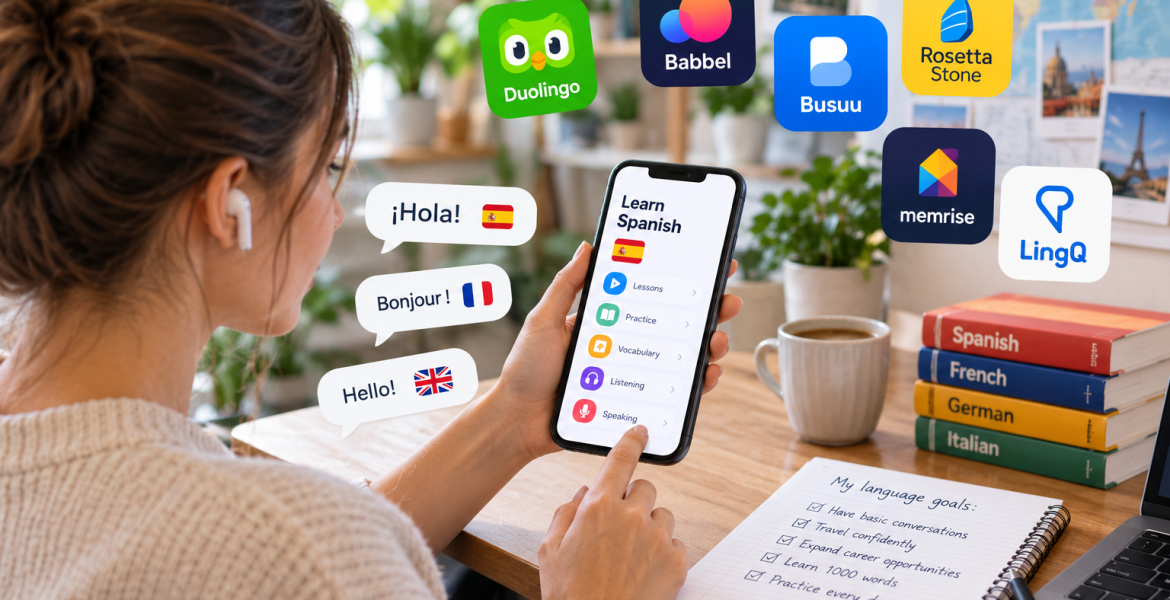
On 1 September 2026 by HabodakoviThere is no single language-learning app that is best for every learner. Duolingo is a strong free choice for gamified daily practice, Babbel offers a more structured course with explicit grammar and practical dialogues, Busuu combines CEFR-based learning with feedback, and Pimsleur is particularly useful for audio-first study. Rosetta Stone suits learners who prefer an immersion-style approach, while LingQ becomes more useful when you want to move into longer real-world reading and listening.
For speaking-heavy practice, newer AI-focused tools such as Speak offer another approach. The right choice depends on your target language, current level and the kind of practice you will actually use consistently.
Best Language Learning Apps in 2026
Here is the quickest way to narrow the options:
| App | Best for | Free option | Main approach |
|---|---|---|---|
| Duolingo | Free daily practice and gamification | Yes | Short, game-like lessons |
| Babbel | Structured self-study | First lessons available free | Guided curriculum, grammar and dialogue |
| Busuu | CEFR progression and feedback | Yes, limited | Structured courses, community and AI practice |
| Pimsleur | Audio and hands-free study | Trial | Spoken recall and audio lessons |
| Rosetta Stone | Immersion-style learning | Trial | Images, audio and pronunciation practice |
| LingQ | Intermediate and advanced input | Limited free plan | Authentic reading and listening |
| Speak | High-volume AI speaking practice | Trial | AI conversation and spoken feedback |
| Memrise | Vocabulary and exposure to natural speech | Yes | Native-speaker video, review and AI practice |
Free tiers and trial conditions change frequently, so check the current plan before choosing an app primarily because it appears to be free.
Duolingo — Best for Free, Gamified Daily Practice
Duolingo remains one of the easiest language apps to start using without paying.
Its main strengths are:
- short lessons;
- streaks and other game mechanics;
- a broad language catalog;
- reading, listening, speaking and writing exercises;
- low friction for daily practice.
Duolingo currently teaches more than 40 languages, and its core courses remain accessible without a paid subscription.
More importantly, some older comparisons now underestimate how far its largest courses go. In 2026, Duolingo expanded nine major course combinations so that their content reaches B2 on the CEFR scale.
Those languages include major courses involving English, Spanish, French, German, Italian, Portuguese, Japanese, Korean and Chinese.
Duolingo — Advanced B2 Course Content
Best for
Duolingo makes sense for:
- beginners;
- learners on a limited budget;
- people trying to create a daily habit;
- users motivated by streaks and game mechanics;
- learners who want short sessions.
Main limitation
Course depth is not identical across all languages.
Do not assume that every Duolingo course goes to B2 simply because some of its biggest courses now do. Smaller language courses can offer substantially less content.
And completing app exercises is not the same as becoming comfortable in spontaneous conversation.
Babbel — Best for Structured Lessons and Grammar
Babbel feels more like a conventional self-study language course than a game.
Lessons tend to emphasize:
- a clear sequence;
- practical dialogues;
- vocabulary in context;
- explicit grammar explanations;
- review;
- pronunciation and speaking exercises.
That makes it a useful alternative for learners who find Duolingo motivating but want more direct explanations of why the language works the way it does.
Babbel currently offers 14 languages overall, although what English-speaking users can study and how far individual courses progress varies.
European Spanish, for example, has content reaching much higher CEFR levels than some of Babbel’s smaller courses. Turkish and several other languages have considerably shorter learning paths.
Babbel — Available Languages and Course Levels
Best for
Babbel is particularly suitable for:
- adults;
- beginners who want structure;
- learners who like explicit grammar support;
- people who prefer a course-like sequence;
- learners of major European languages.
Main limitation
Its language catalog is much smaller than those of services such as Duolingo, Pimsleur or LingQ, and the depth of the courses varies considerably.
Babbel should not be described as teaching all of its languages to the same level.
Busuu — Best for CEFR Progression and Feedback
Busuu is a strong option if you like seeing your progress mapped onto recognizable language levels.
Its courses use CEFR-style progression, and the platform combines structured lessons with:
- grammar and vocabulary review;
- speaking activities;
- feedback from other users;
- progress testing;
- certificates for supported courses and levels;
- AI conversation practice.
Busuu’s newer Conversations feature uses generative AI to create speaking scenarios and provide feedback after the exchange.
Course depth varies by language. Some major courses reach B2 or C1, while others stop much earlier.
Best for
Busuu works particularly well for:
- learners who want visible progression;
- people working toward CEFR-style levels;
- users who value external feedback;
- learners who want more structure than a purely gamified app offers.
Main limitation
Not every language has the same depth, certificates or AI features.
Its free plan also provides less access than the paid tiers, so check what is currently included before assuming the full course is available without a subscription.
Pimsleur — Best for Audio and Hands-Free Learning
Pimsleur stands out because the core experience is built around listening and speaking rather than looking at a screen.
The current platform offers 51 languages and centers its method on 30-minute audio lessons.
It also includes features such as:
- offline learning;
- pronunciation feedback;
- reading lessons;
- flashcards;
- interactive review;
- Apple CarPlay;
- Android Auto.
Best for
Pimsleur is especially useful for:
- commuting;
- walking;
- people who learn well through listening;
- travelers;
- learners who want to speak from the beginning;
- anyone who wants less screen time.
Main limitation
The audio-first format is not ideal for every goal.
If you mainly want extensive reading, writing exercises or detailed grammatical analysis, Pimsleur may work better as one part of your study routine than as the only resource.
Rosetta Stone — Best for Immersion-Style Learning
Rosetta Stone takes a different approach from apps that explain every new word through English.
Its core method relies heavily on:
- images;
- target-language audio;
- pattern recognition;
- pronunciation;
- contextual grammar;
- repetition.
The current platform provides access to 25 languages and uses its TruAccent speech-recognition system for pronunciation practice.
Recent versions have also expanded conversation and personalized learning tools, so Rosetta Stone is no longer simply the picture-matching program many people remember from older reviews.
Best for
Consider Rosetta Stone if you:
- prefer visual learning;
- want less dependence on translation;
- like learning through context;
- want a consistent course format;
- value pronunciation practice.
Main limitation
Some learners prefer more explicit explanations.
If you frequently want to stop and ask, “Why is this grammar form used here?”, Babbel or Busuu may feel more direct.
Immersion-style learning is a method choice, not a guarantee that it will be the best approach for every learner.
LingQ — Best for Intermediate and Advanced Reading and Listening
LingQ is fundamentally different from apps built around short, predetermined exercises.
Its main strength is learning through longer content.
You can work with:
- articles;
- audio with transcripts;
- podcasts;
- web pages;
- YouTube content;
- books and other imported material.
The platform currently supports more than 50 languages and lets users save vocabulary while reading and listening.
That makes it particularly useful once short beginner exercises start feeling too artificial.
Best for
LingQ is a strong option for:
- intermediate learners;
- advanced learners;
- extensive reading;
- listening practice;
- vocabulary growth through context;
- people who want to study topics they genuinely care about.
Main limitation
There is less hand-holding.
Someone who wants a strict sequence of:
Lesson 1 → Lesson 2 → Lesson 3
may find Babbel, Busuu or Duolingo easier at the beginning.
LingQ becomes more compelling when you are ready to spend significant time with real language rather than isolated drills.
Speak — Best for AI Conversation Practice
Speak is built much more directly around speaking aloud than most traditional language apps.
For English speakers, its current language courses include Spanish, French, Japanese, Korean, Italian and Simplified Chinese. It also provides English instruction for speakers of a wider range of languages.
Its learning model combines:
- guided lessons;
- repeated spoken practice;
- pronunciation and phrasing feedback;
- AI conversations;
- personalized Speak Tutor activities.
The emphasis is on producing the language rather than simply selecting answers on a screen.
Best for
Speak is worth comparing if:
- speaking is your main weakness;
- you want frequent conversation practice;
- you feel uncomfortable practicing with another person;
- you want AI feedback and personalized scenarios.
Main limitation
The language catalog is much narrower than Duolingo, Pimsleur or LingQ.
It also should not be treated as a complete substitute for conversations with real people. AI practice can increase the amount you speak, but spontaneous human interaction introduces different accents, interruptions, misunderstandings and social cues.
Memrise — Best for Vocabulary and Real-World Speech Exposure
Memrise has moved beyond being primarily a flashcard and spaced-repetition app.
Its current learning experience places more emphasis on:
- useful phrases;
- vocabulary review;
- videos featuring native speakers;
- listening to natural pronunciation;
- AI conversation practice.
A free option remains available, although paid access unlocks additional features.
Best for
Memrise can be useful for:
- vocabulary building;
- hearing different speakers;
- learners who want short sessions;
- supplementing another structured course;
- people who find textbook audio too artificial.
Main limitation
Memrise’s current product structure and language availability have changed substantially over time, which makes older reviews particularly unreliable.
Check whether the exact language and course features you want are currently available before subscribing.
Best Language App for Speaking Practice
There is no single type of “speaking practice.”
Different apps train different parts of speaking.
Pimsleur
Best when you want guided spoken recall without looking at a screen.
You hear a prompt, retrieve the language and respond aloud.
Busuu
Useful for combining a structured course with speaking exercises, community feedback and AI scenarios.
Speak
Focused heavily on producing spoken language and holding AI conversations.
It is one of the clearest choices if the main reason you are shopping for an app is that you understand a language better than you can speak it.
Real Conversation
None of these is identical to having an unscripted conversation with another person.
If speaking comfortably with people is the goal, eventually add:
- a tutor;
- a language exchange partner;
- conversation groups;
- real-world interaction.
Speaking exercises inside an app and spontaneous conversation are related, but they are not exactly the same skill.
Best Free Language Learning App
Duolingo remains one of the strongest general options if you specifically want to start learning without paying.
Its advantages include:
- free core course access;
- more than 40 languages;
- short lessons;
- gamification;
- beginner-friendly onboarding.
Busuu, LingQ and Memrise also have free or limited-free options, but what they allow without paying differs.
A free tier is also not the same as:
- a free trial;
- one free lesson;
- a money-back guarantee.
If cost is your main criterion, compare the current free plans directly rather than choosing from a general language-app roundup.
Duolingo vs. Babbel
These apps solve different problems.
| Duolingo | Babbel | |
|---|---|---|
| Best for | Habit, gamification and free learning | Structured self-study |
| Free access | Strong | Limited |
| Grammar explanation | Depends on course | More explicit |
| Language selection | Much broader | Smaller |
| Lesson style | Game-like | Course-like |
| Better fit if | Staying motivated is difficult | You want more structure |
Choose Duolingo if low cost, frequent short practice and gamification are priorities.
Choose Babbel if you prefer a more conventional curriculum with grammar explanations and structured dialogues.
Neither is automatically the better language-learning app for everyone.
Best Language Learning App for Fluency
No app can guarantee fluency.
The problem is partly that “fluent” can mean very different things:
- understanding everyday speech;
- holding spontaneous conversations;
- reading novels or news;
- writing accurately;
- working professionally in the language.
Even when an app offers content aligned with B2, completing that course does not automatically mean every learner will perform at B2 in every skill.
Duolingo’s newer B2 material is a good example: it shows that the course content now reaches a more advanced level in selected languages. It does not guarantee a B2 result merely because somebody finishes every unit.
For serious long-term progress, a more complete approach is:
structured study + authentic reading/listening + regular speaking + active writing or recall.
That may mean combining two tools rather than searching endlessly for one perfect app.
Best Language Learning App for Beginners
Beginners have several good options depending on how they like to study.
Duolingo
Choose it if you want:
- free access;
- simple onboarding;
- short daily lessons;
- strong habit-building mechanics.
Babbel
Choose it if you want:
- a clear learning sequence;
- grammar explanation;
- practical dialogues;
- a more traditional course format.
Busuu
Choose it if you want:
- CEFR-style progression;
- structured levels;
- feedback;
- clearer visibility into your progress.
There is no reason every beginner must start with the same app.
Best App for Advanced Language Learners
Advanced learners usually need something different from beginners.
At higher levels, priorities shift toward:
- longer listening;
- authentic texts;
- large vocabulary exposure;
- idiomatic language;
- spontaneous speaking;
- fewer artificial drills.
That is where LingQ becomes particularly useful.
Podcasts, books, native media, tutors and language exchange can also become more important than completing another sequence of beginner-style app exercises.
Do not judge an advanced resource only by how many numbered “levels” it contains.
Best Language Learning Program for Different Goals
| Goal | Strong option to compare |
|---|---|
| Free daily practice | Duolingo |
| Structured paid course | Babbel |
| CEFR progression + feedback | Busuu |
| Audio / commuting | Pimsleur |
| Immersion-style study | Rosetta Stone |
| Advanced reading / listening | LingQ |
| AI speaking practice | Speak |
| Native-speaker video + vocabulary | Memrise |
| Gamification | Duolingo |
| Grammar support | Babbel / Busuu |
| Learn without staring at a screen | Pimsleur |
| Real spontaneous conversation | Tutor / language exchange alongside an app |
“Best” depends on your target language, current level and preferred study method.
Apps vs. Language Learning Software vs. Online Programs
The distinction between a language-learning app, software and program is much less important than it once was.
Many major services now work across several devices.
For example:
- Babbel works through its mobile app and web browser;
- Pimsleur offers app and web access;
- LingQ works across web and mobile;
- Duolingo syncs progress across devices.
So searches for “best language learning software” and “best language learning apps” increasingly lead to the same consumer products.
Online language courses and tutoring platforms are a slightly broader category because they may include live classes or one-to-one instruction rather than self-study lessons.
What to Look for in a Language Learning App
Before paying, answer a few practical questions.
Does It Support Your Exact Language?
Do not assume a service is suitable because it has a large overall catalog.
Check the specific language pair you need.
How Far Does the Course Go?
“Supports Spanish” tells you very little.
Find out whether the course covers:
- basic beginner material;
- A1–A2;
- intermediate B1;
- B2;
- genuinely advanced content.
Course depth can vary dramatically inside the same app.
Does It Make You Produce the Language?
Recognition is easier than recall.
Look for practice involving:
- speaking;
- writing;
- recalling words without hints;
- forming your own sentences.
Does It Fit How You Actually Study?
The technically richest app is useless if you avoid opening it.
Think about your routine:
- commute → Pimsleur;
- five-minute breaks → Duolingo;
- structured desk study → Babbel or Busuu;
- long reading/listening → LingQ;
- frequent spoken practice → Speak.
What Is Actually Free?
Check whether “free” means:
- a genuine ongoing free tier;
- limited features;
- a free trial;
- only the first lesson.
How Does the Subscription Renew?
Before paying, check:
- monthly vs. annual billing;
- automatic renewal;
- cancellation rules;
- whether price differs by platform or region.
Subscription prices change too quickly to be a useful permanent measure of which app is best.
The right language app depends less on which service has the longest feature list and more on the type of practice you need. Duolingo is a strong place to start for free daily study, Babbel and Busuu provide more structured course paths, Pimsleur works particularly well for audio learning, and LingQ becomes useful as you move toward authentic reading and listening. Before paying for any program, check that it supports your language at the level you need and test whether its lesson style is something you will realistically use several times a week.