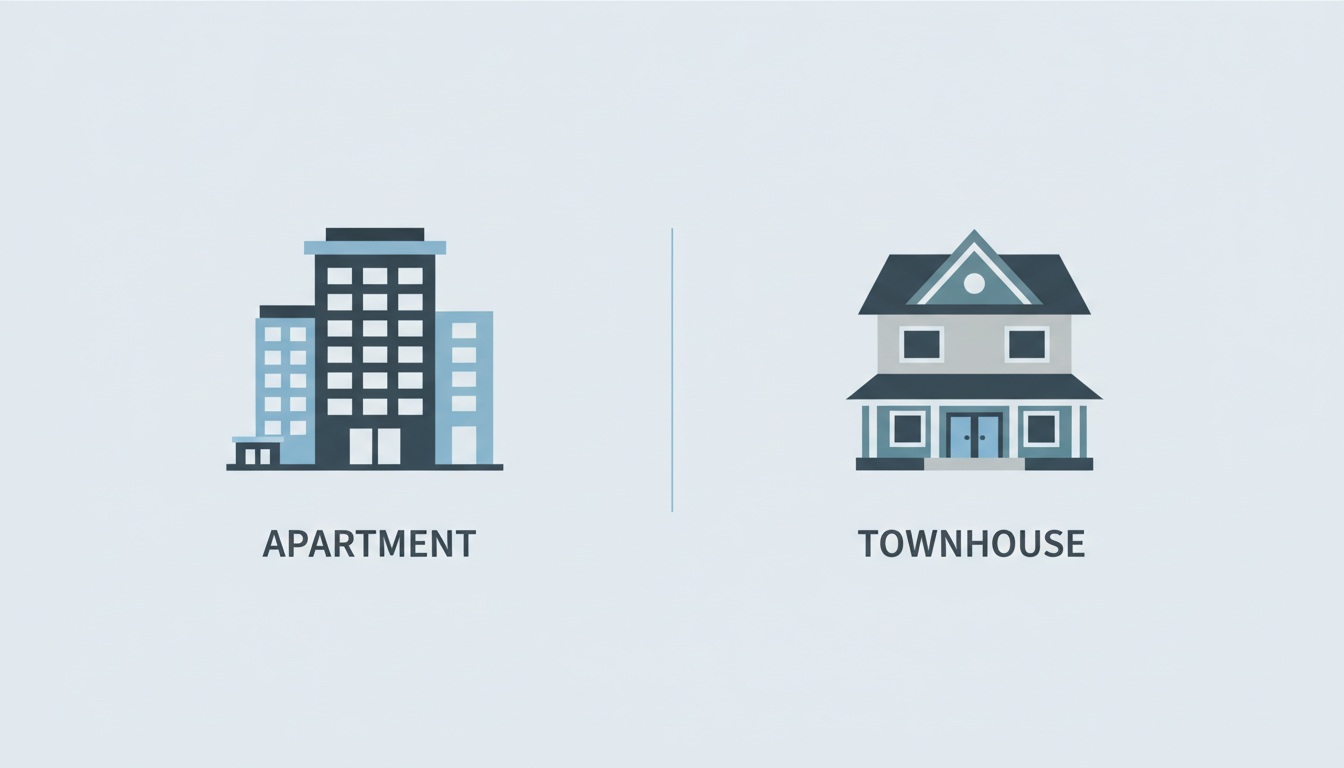
Townhouse vs. Apartment: Structural and Legal Differences
On 27 August 2026 by HabodakoviStructural and Legal Distinctions: Townhouse versus Apartment
In property acquisition, asset management, and urban planning, the terms townhouse and apartment are frequently conflated. While both typologies provide multi-family or medium-density residential housing, they operate under distinctly different legal, operational, and structural frameworks. Conflating these two asset types introduces regulatory compliance risks, inaccurate financial modeling, and misaligned maintenance liabilities.
Common Misconceptions in Property Classification
A primary misconception among practitioners is that the distinction between a townhouse and an apartment is purely architectural. A common operational error is assuming that townhouses are simply multi-story apartments, or conversely, that apartments are merely single-level units within a larger structure. What is the difference between townhouse and apartment assets in practical terms? The variance lies primarily in the legal ownership of the underlying land, the structural envelope, and the allocation of capital expenditure (CapEx) liabilities.
- Structural Independence: Townhouses typically feature vertical configurations with no units above or below, sharing only vertical party walls. Apartments are horizontally and vertically stratified, meaning units share floors, ceilings, and common structural cores.
- Land and Title Structure: Townhouses often carry fee-simple or standard strata titles, which frequently include direct ownership of the footprint land. Apartments are almost universally held under condominium or unit-title regimes, where the land is held in undivided common ownership.
- Operational Governance: While apartment management relies entirely on a central body corporate or homeowners association (HOA) for external envelope repairs, townhouse owners often retain direct statutory responsibility for their specific roofs, exterior facades, and private utility connections.
“Misidentifying property title structures during due diligence leads directly to inaccurate reserve fund allocations and unexpected structural liabilities.”
Risk Profile Analysis: Townhouse vs Apartment
Evaluating townhouse or apartment assets requires an analytical review of risk exposure. When practitioners ask whether townhouses are apartments from a risk perspective, the regulatory and operational answer is negative. The table below outlines the core operational variances that impact long-term asset management.
| Assessment Metric | Townhouse Typology | Apartment Typology | Primary Risk Vector |
|---|---|---|---|
| Envelope Maintenance | Individual or hybrid HOA responsibility | Full HOA / Body Corporate oversight | Deferred facade/roof CapEx |
| Shared Infrastructure | Party walls, localized drainage | Central HVAC, elevators, structural slabs | Catastrophic plant failure |
| Insurable Risk | Often individual structure + liability | Master policy covering the building envelope | Underinsurance of common property |
| Regulatory Compliance | Low-to-medium rise fire codes | High-density life-safety regulations | Egress and active fire system failure |
Mitigating Legal, Financial, and Maintenance Risks
To reduce risk when advising clients, acquiring inventory, or establishing asset management protocols, practitioners must implement standardized verification processes rather than relying on architectural appearance.
1. Title Deed and By-Law Verification
Review the master deed, plat maps, and strata plan to confirm where private ownership ends and common property begins. For townhouses, verify whether the roof membrane is an individual owner liability or maintained via collective reserve funds. For apartments, evaluate the adequacy of the capital works fund relative to the lifecycle of mechanical systems such as elevators and central boilers.
2. Structural Due Diligence
Evaluate party-wall acoustic ratings and fire separation barriers in townhouses, which represent common points of failure in medium-density builds. In apartment assets, prioritize the inspection of waterproofing membranes on common balconies and the structural integrity of cast-in-place concrete slabs.
3. Insurance Allocation Audits
Ensure that property insurance policies align precisely with the governing title structure. In hybrid townhouse developments, ambiguities between master association policies and individual dwelling policies frequently lead to coverage gaps during localized structural losses.
Application Conditions for Portfolio Structuring
Selecting between a townhouse versus apartment framework within a broader real estate portfolio depends on specific operational criteria:
- Townhouse Framework: Preferred when the investment strategy prioritizes underlying land value, lower recurring common-area utility overheads, and autonomous control over exterior renovations.
- Apartment Framework: Suitable for dense urban footprints where centralized operational management, shared amenities, and economies of scale in building-wide service contracts offset the risks of collective decision-making structures.